By NFC Name Cards Editorial Team | Published | Updated | Materials & design
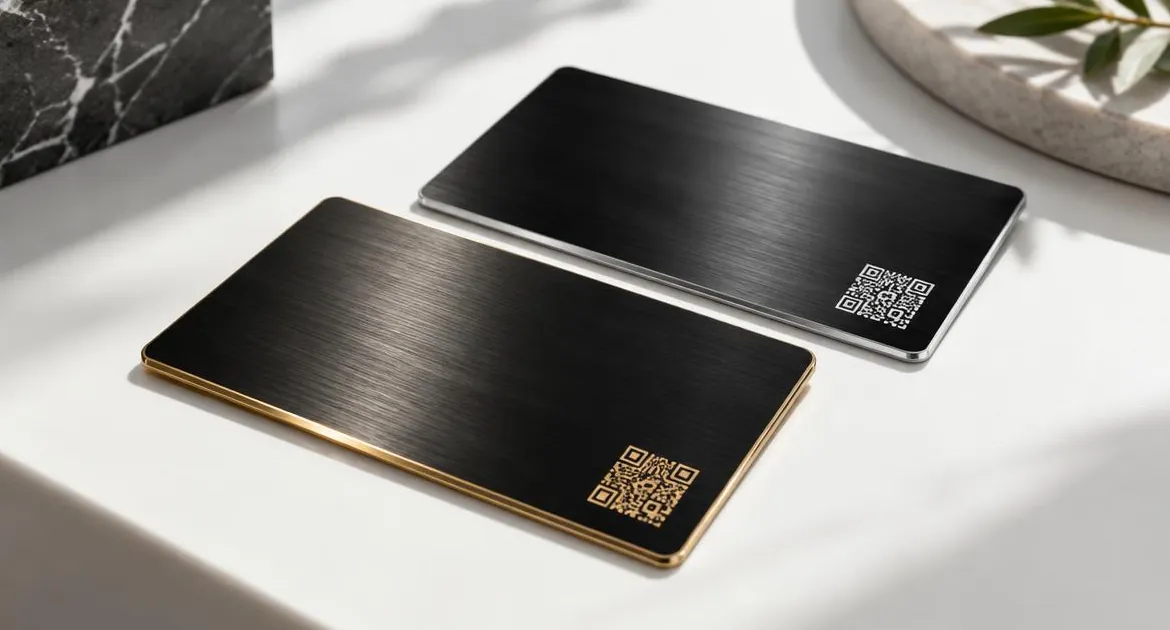
A metal NFC name card is the one people notice. It is heavier than plastic, it feels solid in the hand and it looks premium. It also works a little differently, because metal and radio signals do not mix well.
This guide explains how a metal card works, where to tap it, what it costs over PVC in each store and who it suits. For how every NFC card works, see our guide to how NFC name cards work.
What our metal cards are
Our metal cards are black metal with a gold or silver finish. There are two options: Black & Gold, and Black & Silver.
- Weight and feel. The heaviest of our three materials, with a solid, rigid feel in the hand.
- Look. Dark and premium, with the gold or silver finish.
- Inside. The same kind of NFC chip as every other card, plus a printed QR code.
- Profile. The same editable online profile as PVC and bamboo cards.
The chip, QR code and profile do not change with the material. What changes is the card in your hand.
Why metal cards are built differently
NFC works by a short-range radio field. The phone's reader creates the field, and the chip in the card uses it to wake up and send back its link.
Metal reflects and absorbs radio energy. If you laid a normal NFC chip flat against a sheet of metal, the phone would struggle to read it. So metal NFC cards are built in a way that keeps the chip readable.
The practical result is simple. A metal card usually reads best from one side or one area. A PVC or bamboo card reads easily wherever you hold it.
Where to tap a metal card
The first time you use your card, find its best spot:
- Unlock your own phone.
- Hold the card flat against the back of the phone, near the top on an iPhone or the middle on many Android phones.
- If nothing happens, turn the card over and try again.
- Slide it slowly until the phone responds, then remember that side and position.
From then on, hold the card that way when you offer it. A quick "tap here" with your finger on the right spot makes the first tap reliable for the person you meet.
The phone rules are the same as for any card. A tap works on iPhone XR or later and on Android phones with NFC switched on. Other camera phones scan the printed QR code. Our guide to which phones can read an NFC name card has the details.
What metal costs over PVC
Metal carries the largest upcharge of our three materials. The table shows the upcharge and the metal card price in each store that publishes prices, with the Brand Presence plan.
| Store | Metal upcharge over PVC | Metal card price |
|---|---|---|
| United Kingdom | +£100 | £149 |
| United States | +$130 | $209 |
| Canada | +CA$180 | CA$279 |
| Australia | +A$180 | A$278 |
| United Arab Emirates | +AED 460 | AED 709 |
| India | +₹1000 | ₹1499 |
| International | +$100 | $179 |
Stores that show "Price on request" give metal prices with a quote. The Business Add-ons plan, a logo and removing the platform branding add to the metal price in the same way as for PVC.
Metal cards and phone cases
A thick case, a metal plate for a car mount or a magnetic wallet on the back of a phone can block any NFC tap, whatever the card is made of. With a metal card, which already reads best from one spot, these get in the way more often.
If a tap does nothing after a couple of seconds, do not keep trying. Point to the printed QR code instead. It opens the same profile and does not care about cases.
Who a metal card suits
Metal makes sense when the first impression matters more than the cost per card.
- Executives and senior staff who hand over a card at important meetings.
- Client-facing roles such as advisers, consultants, agents and account managers.
- Pitches and partnerships, where the card is part of how you present yourself.
It makes less sense when you meet many people briefly, such as on a busy stand. There, PVC is more practical, and the profile is the same.
Metal, PVC or wood for this buyer
| Metal | PVC | Bamboo wood | |
|---|---|---|---|
| First impression | Strongest, noticed for its weight | Familiar, like a bank card | Natural, noticed for its grain |
| Weight | Heaviest | Lightest | Light |
| Finishes | Black & Gold, Black & Silver | Black, Green, Brown, Blue | White Bamboo, Original Bamboo |
| Where it reads | Best from one side or area | Easily | Easily |
| Price | Highest | Lowest | In between |
| Best for | Senior and client-facing roles | Everyday use and teams | Natural, plastic-free brands |
For the full comparison of all three, read metal vs PVC vs wood NFC name cards.
Design on a metal card
Your name, role and, as a paid option, your logo are printed on the card. Metal cards are black, so light logos, or a logo that suits the gold or silver finish, read best. Keep the logo simple, because fine lines are harder to see on dark metal.
The card page does not show a Preview for metal cards, so choose your logo version carefully. Our guide to custom NFC name card design covers file types, contrast and checking the details before you order.
Ordering metal for a team
Metal works well for the people in a team who meet senior clients. Each card is ordered with its own finish, name and role, and each links to its own profile. You can mix Black & Gold and Black & Silver in one order, and mix metal with PVC for the rest of the team.
Collect each person's name and role in writing before you order, because personalised cards are printed as entered.
Looking after a metal card
- Keep it flat in a wallet or card slot, away from keys and coins.
- Wipe it with a soft, dry cloth.
- Avoid bending it.
Physical cards carry a 12-month warranty that covers manufacturing faults. Personalised cards are made to order, so they are not returnable for a change of mind.
Is a metal card worth it?
It is worth it if you will hand it to people where the impression counts, and you are happy to show them where to tap. It is not worth it if you need many cards for brief meetings, or if you would rather any spot on the card read the same.
Many teams mix both: metal for the people who meet senior clients, PVC for everyone else. Every card links to its own profile, so the experience after the tap is the same.
You can choose Black & Gold or Black & Silver on the metal option of our NFC name card page.
Frequently asked questions
Which metal finishes do you offer?
Black metal with a gold finish, or black metal with a silver finish.
Is a metal NFC card harder to read?
Metal gets in the way of NFC signals, so metal cards are built to keep the chip readable. They usually read best from one side or area, so find that spot and show people where to tap.
Does a metal card do more than a PVC card?
No. It has the same chip, QR code and editable profile. You pay for the weight, feel and look.
How much does metal add to the price?
It depends on the store. The table in this guide shows the metal upcharge and the metal card price in each store that publishes prices.
Can I put my logo on a metal card?
Yes. Adding your logo is a paid option on every material, including metal.
Does the QR code work on a metal card?
Yes. Every metal card has a printed QR code that opens the same profile as the chip.
Can I preview a metal card before I order?
The card page shows a Preview for PVC cards only. For metal, check your name, role and logo version carefully before you add the card to your basket.