By NFC Business Cards Editorial Team | Published | Updated | Materials & design
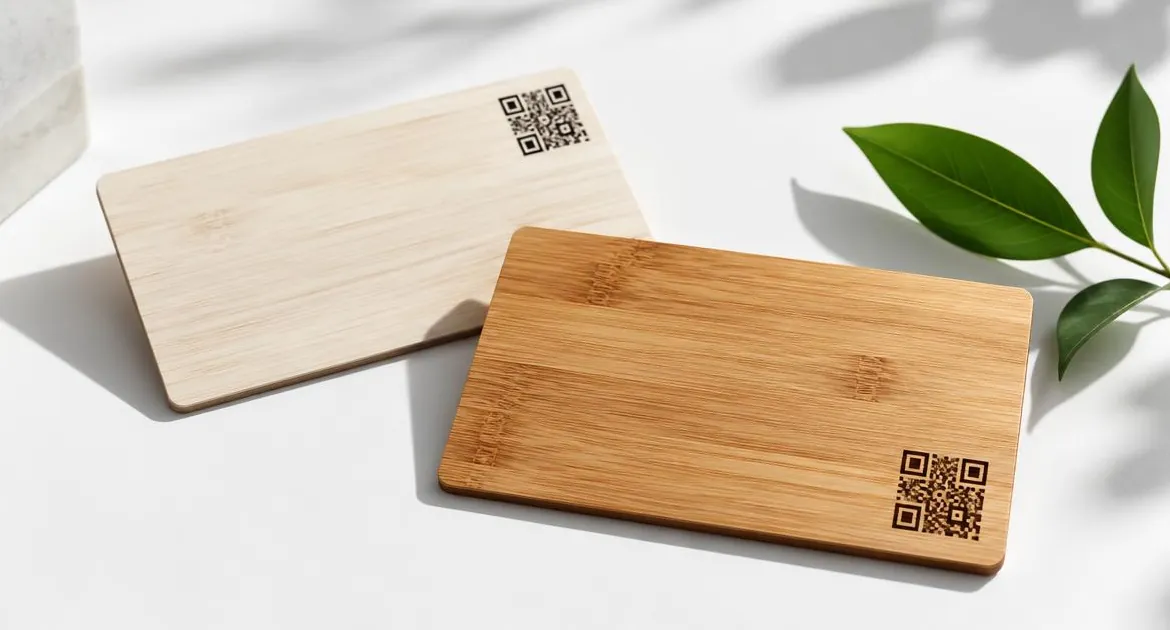
A wooden NFC business card is the one people turn over in their hands. The grain is visible, the card feels warm and no two look exactly alike. Ours are made from bamboo, and they work exactly like our PVC and metal cards.
This guide covers what you get, how it looks and feels, how to look after it, what it costs in each store and who tends to choose it. For how every NFC card works, read our guide to how NFC business cards work.
What our wooden cards are
Our wooden cards are bamboo, in two finishes:
- White Bamboo: a pale finish with light grain.
- Original Bamboo: a warmer, natural tone.
Every bamboo card has an NFC chip inside and a printed QR code, and both open your online profile. Your name, your role and, as a paid option, your logo are added to the card for you. The card page does not offer a choice of finishing method, so design for clear contrast against the grain.
Look and feel
- Weight. Light, close to PVC and well below metal.
- Feel. Warm to the touch, with a natural surface.
- Look. Visible natural grain. Each card's grain is slightly different.
That variation is part of the appeal. If you order several cards, expect each one to look a little different from the next.
How it reads
Wood, like plastic, does not get in the way of NFC. A bamboo card reads easily wherever you hold it against the phone, without hunting for one spot. The phone rules are the same as for every card: a tap works on iPhone XR or later and on Android phones with NFC switched on, and other camera phones scan the printed QR code.
What it costs in each store
Bamboo carries an upcharge over PVC that is lower than metal's. The table shows the upcharge and the bamboo card price in each store that publishes prices, with the Brand Presence profile plan.
| Store | Bamboo wood upcharge over PVC | Bamboo wood card price |
|---|---|---|
| United Kingdom | +£50 | £99 |
| United States | +$70 | $149 |
| Canada | +CA$90 | CA$189 |
| Australia | +A$90 | A$188 |
| United Arab Emirates | +AED 230 | AED 479 |
| India | +₹500 | ₹999 |
| International | +$50 | $129 |
Stores that show "Price on request" give bamboo prices with a quote. The Business Add-ons plan, a logo and removing the platform branding add to the bamboo price in the same way as for PVC.
Bamboo, PVC or metal for everyday carry
| Bamboo wood | PVC | Metal | |
|---|---|---|---|
| Weight in a wallet | Light | Lightest | Heaviest |
| Feel | Warm, natural grain | Smooth printed plastic | Solid and rigid |
| Finishes | White Bamboo, Original Bamboo | Black, Green, Brown, Blue | Black & Gold, Black & Silver |
| Where it reads | Easily | Easily | Best from one side or area |
| Moisture | Keep dry | Everyday handling | Everyday handling |
| Price | In between | Lowest | Highest |
If the card lives in a phone case or a slim wallet, all three fit. Bamboo and PVC add the least weight.
For more on the heaviest option, read our guide to metal NFC business cards. For the everyday choice, see PVC NFC business cards.
Care and moisture
Bamboo is a natural material, so it needs a little more care than plastic or metal.
- Keep it dry. Do not soak it or leave it in water. If it gets wet, wipe it and let it dry naturally.
- Avoid heat. Do not leave it on a radiator, in direct sun behind glass or on a car dashboard for long periods.
- Keep it flat. Carry it in a wallet or card slot, not loose in a bag where it can bend or rub against keys.
- Wipe, do not scrub. A soft, dry cloth is enough.
Avoid bending any card sharply, because that can damage the antenna inside. Physical cards carry a 12-month warranty that covers manufacturing faults.
Honest environmental wording
People often choose bamboo because it feels like the greener option. We want to be careful here.
- We do not publish an environmental comparison between our materials, so we do not claim that bamboo is better for the planet than PVC or metal.
- What we can say is factual: it is a natural material, it gives a plastic-free look, and every card has the same chip and QR code.
- One reusable card can replace repeat print runs of paper cards when your details change, because you edit the profile instead of reprinting. That holds for every material, not just bamboo.
If sustainability matters to your brand, describe the card in those plain terms rather than with claims you cannot back up.
Designing for bamboo
The grain is pale, so contrast matters.
- A dark, solid logo usually reads best.
- Avoid very pale colours and thin type, which can get lost in the grain.
- Keep the name and role short, so they stay clear.
The card page shows a Preview for PVC cards only, so take extra care choosing your logo version for bamboo. If you upload a logo, a PNG or SVG with a transparent background usually works best.
What people notice at a handover
With a bamboo card, the material does some of the talking. People tend to notice the grain and the warmth before they tap. That gives you a natural opening: "it's bamboo, tap it near the top of your phone." After that, the experience is the same as with any of our cards: the profile opens, and they save your contact.
Who a wooden card suits
- Natural and outdoor brands that want the card to match their look.
- Creative studios and makers who like a card people want to hold.
- Anyone who wants something different from plastic, without the weight or price of metal.
It suits people less if the card will often get wet, or if you need many cards for a large team where PVC keeps costs down.
Ordering a bamboo card
- Choose wood as the card type on the card page, then White Bamboo or Original Bamboo.
- Pick your profile plan.
- Type your name and role, and add your logo if you want one.
- Check the spelling, because personalised cards are not returnable for a change of mind.
- Add the card to your basket and pay once.
When it arrives, set up your profile, then tap the card and scan the QR code on your own phone to check both open it.
You can choose your bamboo finish on the wood option of our NFC business card page.
Frequently asked questions
Which wooden finishes do you offer?
White Bamboo and Original Bamboo.
Does a wooden NFC card work as well as plastic?
Yes. Wood does not get in the way of NFC, so a bamboo card reads easily, and every card also has a printed QR code.
Can a bamboo card get wet?
Keep it dry. If it gets wet, wipe it and let it dry naturally. Do not soak it.
Is bamboo better for the environment?
We do not publish an environmental comparison between materials, so we make no claim either way. Bamboo is a natural material with a plastic-free look.
How much more does wood cost than PVC?
It depends on the store. The table in this guide shows the bamboo upcharge and card price in each store that publishes prices.
Will every card in my order look the same?
Not exactly. Each card's grain is slightly different, which is part of the look.
Can I put my logo on a bamboo card?
Yes. Adding your logo is a paid option on every material. A dark, solid version of your logo usually reads best on the pale grain.