By NFC Business Cards Editorial Team | Published | Updated | Materials & design
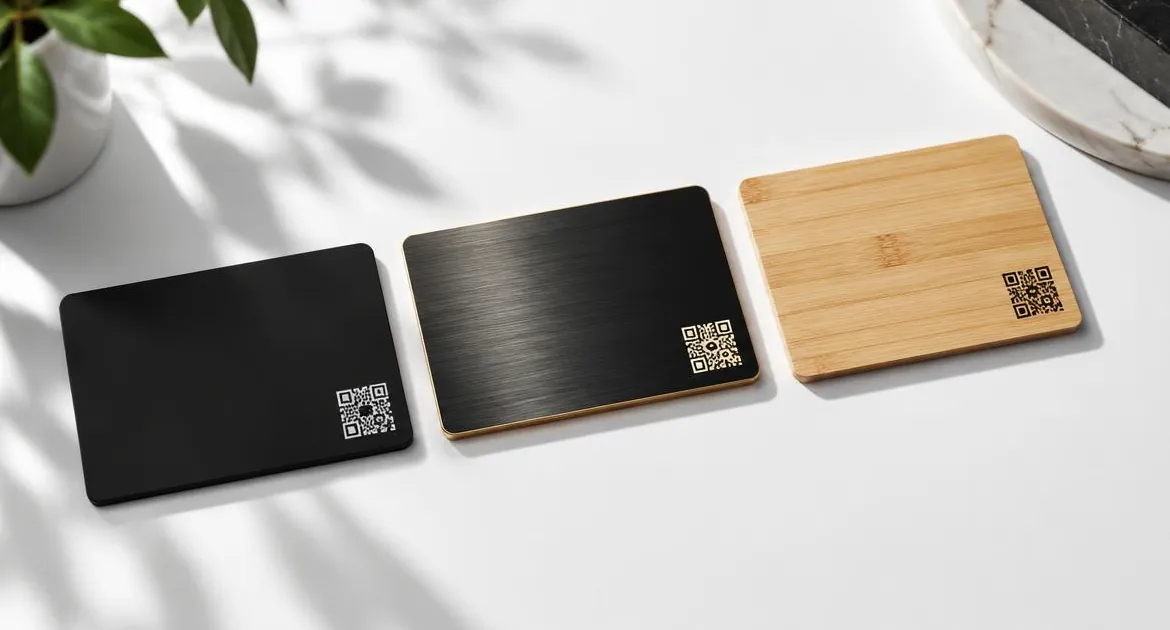
The material is the part of an NFC business card people notice first. It is also the only part that changes between our cards. The chip, the printed QR code and the profile behind them are the same on all three.
This guide compares PVC, metal and bamboo wood: the finishes, how each one feels, what it costs in your store and who tends to choose it. For how the chip and profile work, see our guide to how NFC business cards work.
Materials and prices at a glance
| Material | Finishes | Weight and feel | Price |
|---|---|---|---|
| PVC | Black, Green, Brown, Blue | Lightest option; standard card thickness that fits any wallet | $79 |
| Bamboo wood | White Bamboo, Original Bamboo | Light and warm to the touch; each card’s grain is slightly different | $129 |
| Metal | Black & Gold, Black & Silver | Heaviest option with a solid, rigid feel in the hand | $179 |
The price shown is for the card with the Brand Presence profile plan, paid once. The Business Add-ons plan, a logo and removing our branding each add to it. The NFC business card page shows every combination with its price.
What stays the same on every material
Whichever material you pick, these do not change:
- The chip and QR code. Every card has an NFC chip and a printed QR code that open the same profile.
- The profile. You edit it online at any time, and the card never needs reprinting.
- The phones. iPhone XR or later and Android phones with NFC switched on open the card with a tap. Other camera phones scan the code. Our guide to which phones can read an NFC business card has the details.
- The payment. You pay once for the card and profile plan, with no monthly fee.
- The warranty. Physical cards carry a 12-month warranty for manufacturing faults.
So the choice is about the card in your hand: how it looks, how it feels and what it costs.
PVC
PVC is the plastic used for most bank and membership cards. We offer it in Black, Green, Brown and Blue.
- Weight and feel. The lightest option, at standard card thickness. It fits any wallet or card slot.
- Look. Smooth printed plastic in a choice of four colours.
- Signal. Plastic does not get in the way of NFC, so the card reads easily.
- Price. The lowest of the three. It is the base price on the card page.
- Often chosen for. Everyday use, larger team orders and a first NFC card.
Metal
Our metal cards are black metal with a gold or silver finish: Black & Gold, or Black & Silver.
- Weight and feel. The heaviest option, with a solid, rigid feel in the hand.
- Look. Dark and premium, with a gold or silver finish.
- Signal. Metal reflects radio signals, so a chip simply laid on metal would struggle to be read. Metal NFC cards are built so the chip stays readable, but they usually read best from one side or area. Learn which spot works on your card and show people where to tap.
- Price. The highest of the three. The table above shows the price in your store.
- Often chosen for. Executives, client-facing roles and meetings where the first impression matters most.
You can see the metal finishes in the metal section of the card page.
Bamboo wood
Our wooden cards are made from bamboo, in White Bamboo or Original Bamboo.
- Weight and feel. Light and warm to the touch.
- Look. Visible natural grain. Each card's grain is slightly different, so no two look exactly alike.
- Signal. Wood, like plastic, does not get in the way of NFC.
- Price. Between PVC and metal.
- Often chosen for. Brands that want a natural, plastic-free look.
What changes and what does not
| PVC | Metal | Bamboo wood | |
|---|---|---|---|
| Finishes | Black, Green, Brown, Blue | Black & Gold, Black & Silver | White Bamboo, Original Bamboo |
| Weight | Lightest | Heaviest | Light |
| Feel | Smooth printed plastic | Solid and rigid | Warm, natural grain |
| Where it reads | Easily | Best from one side or area | Easily |
| Price | Lowest | Highest | In between |
| NFC chip and QR code | Yes | Yes | Yes |
| Editable profile | Yes | Yes | Yes |
What the person you meet notices
The material shapes the first second of the exchange, before anyone taps.
- PVC feels familiar, like a bank card. The colour is what people notice, so pick the one that suits your brand.
- Metal is noticed for its weight as soon as it touches someone's hand. That is the reason most people choose it.
- Bamboo wood is noticed for its grain and warmth. People often turn it over to look at it.
After that first second, the experience is the same on every card: a tap or a scan, and your profile opens.
Your design on each material
Your name, role and logo are printed on the card whichever material you choose, and the QR code is printed on every card. A logo with strong contrast reads well on all three. A light logo suits black PVC or black metal, while a dark logo suits the paler bamboo. If your logo has fine detail, keep it simple so it stays clear at card size. Adding your logo and removing our branding are paid options, priced on the card page.
How to choose
Four questions usually settle it.
- Who will you hand it to? For senior clients or an important pitch, metal makes the strongest impression. For a trade show where you meet many people, PVC is the practical choice.
- How many cards do you need? For a team, PVC keeps the cost down. Each card still links to its own profile.
- What does your brand look like? A natural or outdoor brand fits bamboo. A dark, premium brand fits black metal. A colourful brand may suit one of the four PVC colours.
- Are you happy to show people where to tap? With metal, a quick "tap here" makes the first tap reliable. PVC and wood read easily wherever you hold them.
If you are still unsure, PVC is a sensible first card. Your details live on the profile, so you can order another material later and point it at the same profile. Our guides to PVC NFC business cards and wooden NFC business cards go deeper on each.
Cards for a team
Teams often mix materials. A common pattern is PVC for most of the team and metal for the people who meet senior clients. Every card links to its own profile, so each person shares their own details whatever the material.
Ordering several cards is the same as ordering one: choose the material and plan for each card on the NFC business card page, and add the name and role to show on each. If people later move role or leave, their profile changes, not the card, so a card can be passed to a new team member and pointed at a new profile.
Looking after your card
- Keep the card flat in a wallet or card slot, not loose in a bag with keys.
- Wipe metal and PVC cards with a soft, dry cloth.
- Keep bamboo cards dry, and let one dry naturally if it gets wet.
- Avoid bending any card sharply, as that can damage the antenna inside.
If you want to know what the chip stores, and what someone sees when they tap any of these cards, read our guide to whether NFC business cards are secure.
Frequently asked questions
Does the material change what the card can do?
No. All three have the same chip and QR code and open the same editable profile. The material changes the look, weight, feel and price.
Which material is the cheapest?
PVC. Bamboo wood costs more, and metal costs the most. The table near the top of this guide shows the price of each in your store.
Is a metal NFC card harder to read?
Metal gets in the way of NFC signals, so metal cards are built to keep the chip readable. They usually read best from one side or area, so learn the right spot and show people where to tap.
Which PVC colours can I choose?
Black, Green, Brown and Blue.
Can I put my logo on any material?
Yes. Adding your logo is a paid option for every material, and you upload it before the card goes in your basket.
Can people on my team have different materials?
Yes. Each card is ordered with its own material, plan, name and role, and links to its own profile. Many teams choose PVC for most people and metal for those who meet senior clients.
Can I return a card if I change my mind about the material?
Personalised cards are made to order, so they are not returnable for a change of mind. The 12-month warranty covers manufacturing faults.